

A construction loan calculator is an essential tool for anyone considering building a home in North Idaho. For prospective home builders in Coeur d’Alene, Hayden, Post Falls, Rathdrum, Hayden Lake, Spirit Lake, Dalton Gardens, or anywhere across Kootenai County, understanding how a construction loan calculator works is crucial before breaking ground. This article is designed specifically for those planning to build in North Idaho, guiding you through what a construction loan calculator does, what numbers you need to estimate, and how these tools differ from standard mortgage calculators.
How a Construction Loan Calculator Fits Into Your North Idaho Build
Scope:
This guide covers the key numbers you should estimate before applying for a construction loan, explains how construction loan calculators work, highlights the differences between construction and standard mortgage calculators, and addresses North Idaho-specific factors that can impact your loan estimate.
Target Audience:
Prospective home builders in North Idaho who want to understand the financial commitment of building property and how to use a construction loan calculator effectively.
Why It Matters:
Understanding construction loan calculators before you build helps you organize your budget, anticipate monthly payments during construction, and avoid surprises as you move from the building phase to your permanent mortgage.
Definition Box: What Is a Construction Loan Calculator?
A construction loan calculator helps estimate the financial commitment of building property. Unlike standard mortgage calculators, these tools account for the unique way funds are released in stages, estimate monthly payments during construction, help determine interest-only payments, and provide a breakdown of principal and interest payments.
Construction Loan Calculator: What Does It Typically Include?
- Staged Funding: Accounts for the unique way funds are released in stages during construction.
- User Inputs: Lets you enter loan amount, interest rate, and project length.
- Monthly Payment Estimates: Calculates monthly payments during the construction phase.
- Interest-Only Payments: Helps determine interest-only payments during construction.
- Principal/Interest Breakdown: Provides a breakdown of principal and interest payments across both construction and permanent phases.
Introduction
If you are planning to build a dream home in North Idaho, the numbers can feel overwhelming before a single shovel hits the ground. A construction loan calculator can help estimate the financial commitment of building property by organizing inputs like land price, cost of construction, and projected payment into one picture. More detailed construction loan calculators may also account for the way funds are released in stages, which separates construction financing from standard financial calculators.
That said, no online tool can replace a personalized construction financing review. At Home Lending is an independent mortgage brokerage in Coeur d’Alene that helps prospective borrowers compare construction loan options from participating lenders rather than offering one standard program. Construction financing in Idaho generally depends on borrower profile, builder qualifications, land characteristics, plans, specs, budget, and appraisal, all of which go beyond what a simple calculator can capture.
This article walks through the key inputs you should estimate before applying for a construction loan in North Idaho. Nothing here constitutes live rates, APRs, or guaranteed loan terms. All descriptions are general and may vary by lender, program, and borrower, and a local mortgage broker in Coeur d’Alene can help interpret them for your specific situation.

Using a Mortgage Calculator vs. a Full Construction Loan Calculator
At Home Lending’s online mortgage calculator can help you estimate a possible future permanent mortgage payment for your completed home, but it is not a home construction loan calculator. A standard loan calculator lets you input a calculated loan amount, an expected interest rate, and a repayment term to preview a principal and interest payment on the final mortgage loan. That is useful for long-term payment planning.
A full construction loan calculator would also need to model construction loan payments during the build, draw schedules, interest only periods, inspection fees, and changes in the initial mortgage balance as funds are released. Scenario modeling in construction loan calculators helps evaluate different financial outcomes by letting users input loan amount, interest rate, and project length together. These calculators estimate monthly payments during construction and help determine interest-only payments during construction, providing a breakdown of principal and interest payments across both phases.
Because construction loans in North Idaho may be structured differently by each participating lender, whether construction-only, construction to permanent, or other loan type options, a generic online calculator usually oversimplifies the picture. Use the mortgage calculator to estimate a comfortable long-term payment, then bring that target into a conversation with At Home Lending to see which Idaho construction loan options might support it.
Next, let’s explore the key numbers you should gather before applying for a construction loan in Idaho.
Key Numbers to Estimate Before You Apply for an Idaho Construction Loan
Before formally starting a construction loan application, it helps to organize the core numbers that shape any estimated construction loan scenario and review how your credit score factors into mortgage approval.
Essential Inputs for Your Calculator
Checklist of Key Numbers
Gather the following information to prepare for your construction loan estimate:
- Land purchase price or current land value
- Construction budget (builder’s detailed bid)
- Site-work and infrastructure costs
- Borrower contribution (down payment or land equity)
- Closing costs
- Contingency reserve
- Draw and inspection costs
- Interest during construction
- Final permanent mortgage payment
Total project costs can include land value, labor, materials, permits, site work, utility connections, and other construction-related expenses. National benchmarks for the average cost to build a house or average price per square foot can provide general context, but they should not be treated as reliable numbers for a specific North Idaho construction loan estimate. Actual construction costs shift based on terrain, materials, builder availability, project scope, and local site conditions.
Realistic cost estimates are crucial when using a construction loan calculator to avoid over-optimism. Accurate cash flow mapping helps align personal finances with construction costs so you can have productive conversations with builders, real estate agents, and a loan advisor early, especially as Idaho mortgage rates change over time. These estimates will evolve as final plans, bids, and appraisals come in, and flexibility matters when building in areas with seasonal construction windows like Kootenai County winters.
With these numbers in hand, let’s look at how land costs and equity factor into your construction loan estimate.
Land Cost, Land Equity, and North Idaho Lot Considerations
Land fits into an Idaho construction loan in two ways. You may be purchasing a lot and building later, or you may already own land and bring land equity into the project as part of your borrower contribution, and this interacts with the different types of mortgage loans you might use for the permanent financing.
For buyers making an offer on a lot in Coeur d’Alene, Hayden Lake, Spirit Lake, or rural Kootenai County, the land purchase price generally becomes part of the overall cost reviewed by a lender alongside the construction budget. For owners who purchased land earlier or inherited acreage, a lender may consider current appraised land value minus any existing liens when evaluating the calculated required down payment and equity position.
In North Idaho, lot characteristics matter. Steep slopes above Lake Coeur d’Alene, timbered acreage near Athol or Spirit Lake, and access via private or gravel roads can all influence appraised value and project feasibility. Most lenders require a clear construction plan for loan approval, and lot constraints feed directly into that review.
Before seeking a construction loan estimate, gather recent purchase documents, any existing surveys, and basic loan information on access, utilities, wells, septic systems, and recorded easements. Land value, land equity credit, and acceptable loan-to-value ratios are determined by the specific lender and loan program.
Once you understand how land costs and equity are factored in, the next step is to estimate your construction budget, site work, and contingency reserves.
Estimating Your Construction Budget, Site Work, and Contingency
The cost of construction on a calculator should reflect more than just the vertical build. It should include site work and a realistic contingency reserve for North Idaho conditions.
Site-Specific Budget Considerations
Common construction budget components include:
- Excavation and grading
- Foundation (footings, slab, crawlspace, or basement)
- Framing, roofing, windows, and doors
- Mechanical systems (plumbing, electrical, HVAC)
- Interior finishes, cabinets, flooring, and paint
- Contractor overhead and profit
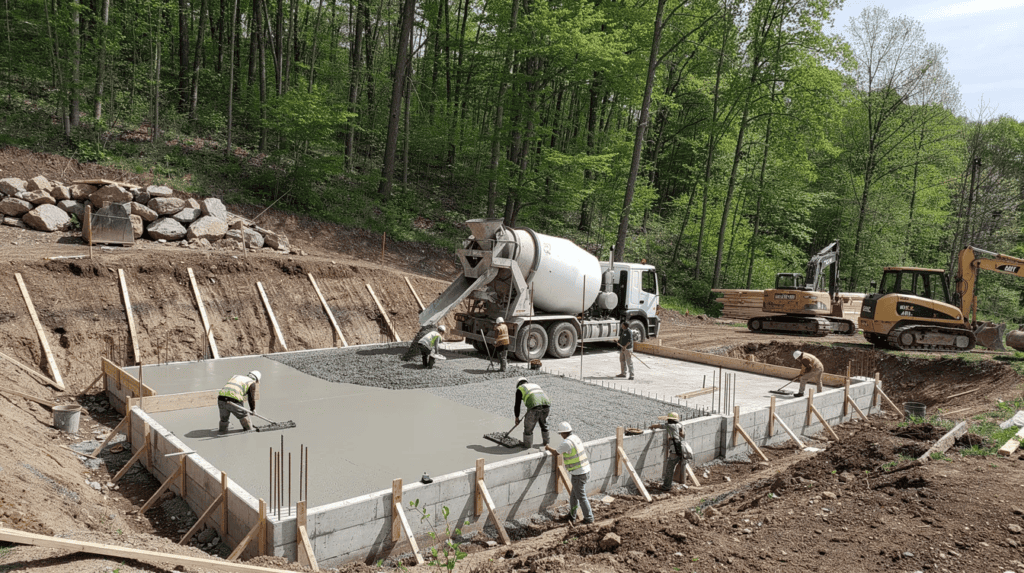
Site-specific costs frequently affect projects in Kootenai County: driveways on sloped or timbered lots, private road improvements, wells or community water connections, and septic design and installation. In rural Idaho, combined well and septic systems may run $18,000 to $45,000 depending on depth, soil type, system design, and permitting. Rock excavation and snow management add further line items.
Permits, utility hook-ups, impact fees, and required engineering should all appear in the budget.
Contingency Planning
A contingency reserve is often used in construction projects because construction costs can change due to material fluctuations, change orders, subsurface rock, weather delays, or unexpected site conditions. Work closely with a licensed, experienced North Idaho builder and a local home loan specialist in Coeur d’Alene to refine these numbers before relying on any calculator-based estimate of a construction loan amount.
After you have a clear construction budget, it’s important to understand how your borrower contribution, closing costs, and payment structure will affect your loan.
Borrower Contribution, Closing Costs, Draws, and Interest Only Payment During Construction
Borrower contribution, typically a down payment, land equity, or a combination, directly affects the loan-to-value ratio that lenders review. Borrowers may see general references to a 20% down payment for some construction loans, FHA 3.5% down payment options, VA 0% down payment benefits, or USDA 0% down financing in eligible rural areas. However, those figures should not be treated as universal construction loan requirements. Actual borrower contribution depends on the loan program, lender, occupancy, land equity, borrower profile, builder approval, property type, construction budget, and current program availability.
Construction loans can involve more documentation than traditional mortgages because the lender reviews both the borrower and the construction project. Interest rates for construction loans may price differently from mortgages for an existing home, depending on the lender, loan program, borrower profile, builder, property, and project risk. Closing costs in a construction scenario may include standard loan fees, title charges, recording fees, appraisal costs, and program-specific charges, which an independent Idaho mortgage brokerage offering customized strategies can help you compare.
How Draws and Payments Work
Construction financing often works on a progressive disbursement system. Draw schedules determine the timing of funds disbursement during construction, and staged draw phases involve payouts as specific construction milestones are completed. In some construction loan structures, interest is calculated on the amount that has been drawn from the loan, so construction loan payments may change as construction progresses and more borrowed money is released. A construction-only loan may use interest-only payments during construction, while construction-to-permanent loans combine construction financing and the permanent mortgage into one loan structure. Some programs may allow interest reserves to cover construction phase payments, depending on the lender and overall project profile.
With your payment structure in mind, the next step is to understand how the appraised value of your completed home impacts your loan amount.
Appraised As-Completed Value vs. Your Construction Budget
The expected appraised value, sometimes called as-completed value, is the estimated market value of your finished home and land once the construction project is fully built. An appraiser reviews plans, specs, the lot, and comparable sales to arrive at this figure.
This expected appraised value is a key figure in construction loan calculations, but it may not match the total construction budget plus land cost. The two numbers can diverge for several reasons:
- Overbuilding for a specific neighborhood or property type
- Highly customized or luxury finishes that the local market does not fully reward
- Unusual acreage combinations with limited recent comparable sales near Hayden Lake, Rathdrum, or Dalton Gardens
- Shifting market conditions between planning and completion
Lenders typically look at both the total cost and the appraised as-completed value when determining the maximum loan amount, subject to each program’s loan-to-value guidelines. The maximum loan minus the borrower’s required contribution helps determine the calculated loan amount. Some construction loan calculators may include fields for FHA, VA, USDA, or conventional loan assumptions, but any calculator report is only as accurate as the inputs and should be reviewed against actual lender and program requirements.
Do not assume every dollar spent automatically converts into value. If your design choices could significantly exceed nearby resale prices, speak with At Home Lending early to understand how that gap affects your total loan and financing options, and consider requesting no-obligation mortgage quotes to compare scenarios.
Now that you know how appraised value factors in, let’s review the unique North Idaho factors that can impact your construction loan estimate.
North Idaho-Specific Factors That Affect Your Construction Loan Estimate
What makes construction estimates in North Idaho different from more urban or flat markets comes down to terrain, infrastructure, and climate.
Acreage projects around Spirit Lake, Athol, or east of Rathdrum may involve longer driveways, private roads, tree removal, and additional grading. These costs should appear in both budget and contingency assumptions before using any construction loan calculator. Wells and septic systems vary widely from one parcel to another. Drilling depth, pump requirements, septic design type, and drain-field location should not be assumed based on averages. Well drilling alone in Idaho can range from $2,000 to over $10,000 depending on depth and geology.
Utilities and access present their own challenges: power extensions, propane tanks, internet options, and year-round access on steep or unmaintained roads, especially for homes above Lake Coeur d’Alene or in more remote Hayden Lake and Fernan Lake areas.
Winter access and build seasons directly affect the length of project timelines. Snow, frozen ground, and limited subcontractor availability can extend construction periods, increasing interest during construction and shifting draw schedules. Appraisals for unique properties such as view lots, timbered ridges, or lake-area parcels with very few comparable sales may require especially careful review, which can influence the remaining balance, final interest calculations, and overall cost of the loan.

With a clear understanding of local factors, you’re ready to see how the construction phase transitions into your permanent mortgage and what steps to expect next.
From Construction Phase to Permanent Mortgage: Payment Planning and Next Steps
Two common construction loan structures are stand-alone construction loans and construction-to-permanent loans.
Steps from Construction to Permanent Mortgage
- Construction Phase: You receive funds in stages (draws) as the home is built, making interest-only payments on the amount drawn.
- Completion: Once construction is finished and all required conditions are satisfied, the loan transitions.
- Permanent Mortgage: The loan converts to a standard mortgage, and you begin making regular principal and interest payments.
In Idaho, some borrowers use other strategies, such as a stand-alone construction loan followed by a refinance, or a home improvement loan into mortgage structure for certain projects, depending on eligibility and lender participation. Once the home is complete, the focus shifts to the monthly payments most borrowers care about most: the final principal and interest payment on the permanent mortgage. You can begin to approximate this using At Home Lending’s mortgage calculator to estimate your mortgage payment under different scenarios.
Review your comfort level with both phases: the variable construction loan payments driven by draws and only interest charges during construction, and the stable long-term payment you expect after the loan converts. Whether you are exploring an FHA construction loan, conventional options, low interest rates, higher interest rates, or a one-time close construction loan in Idaho, the loan terms and interest rate enter into every scenario differently.
A larger down payment may reduce the principal balance and interest payment burden over time, but understanding the maximum loan, calculated required contribution, and complete construction loan process for your specific project is something no calculator alone can do. Contact At Home Lending to discuss your construction project, land details, builder, budget, and financing options, and request a personalized construction loan estimate tailored to your North Idaho goals. Building a home starts with the right numbers and the right conversation.
Construction Loan Calculator FAQ & Summary
What does a construction loan calculator do?
A construction loan calculator helps estimate the financial commitment of building property. It accounts for the unique way funds are released in stages, estimates monthly payments during construction, helps determine interest-only payments during construction, and provides a breakdown of principal and interest payments.
How is a construction loan calculator different from a standard mortgage calculator?
Unlike standard mortgage calculators, which only estimate payments on a fixed loan amount over a set term, a construction loan calculator models the staged funding process, interest-only payments during construction, and the transition to a permanent mortgage. It allows users to input loan amount, interest rate, and project length, and provides a detailed breakdown of payments across both construction and permanent phases.
Ready to take the next step?
Contact At Home Lending for a personalized construction loan estimate and expert guidance tailored to your North Idaho home building goals.